Don’t you hate those one-word answers from teens when you’re really trying, and perhaps fumbling to start a conversation? If you ask them, “Did you have a nice day?” and you feel lucky to get one word, “Yes.” or “No.” Well, you’re not alone. It sounds like you have a perfectly normal teenager. But connecting is important and sometimes a little different approach to a conversation starter can open the gates of dinnertime conversation. So here’s a way to lighten up and have fun at the table.
Continue reading
Category Archives: Parenting & Kids
Back to School Dinner Solutions
Back to School usually means busy nights start up again. Don’t let those additional responsibilities discourage you from getting a great meal on the table.
These dinners not only cook in under 30 minutes but travel well. Take them on a picnic or as dinner in the car to the next sporting event.
- BBQ Chip Chicken Tenders
- Central Park Garlic Chicken
- Carne Asada Steak Tacos
These dinners work great in the crockpot. Continue reading
It’s official! Check it out…
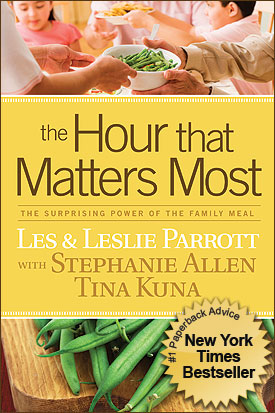
The Hour That Matters Most
just hit #1 on the
New York Times Bestseller list!
Don’t have a copy? Order now. We know your family will enjoy it.
Also makes for a great high value gift this season. Continue reading
Kids & summer weight gain
When school is out for the summer it may be more important than ever for kids to get regular physical activity and eat a nutritious diet. According to an article published in the American Journal of Public Health, kids tend to gain three times as much weight during the summer as they do during the school year.
One reason is that they probably spend more time watching television and playing video games. The other is that they can eat whenever they want during the summer, in contrast to when they are in school and eat only at a few set times.
Television also exposes children to more commercials for high-calorie snack foods, fast food, and fattening sweets. Try to limit kids’ screen time to no more than two hours per day. A study by the Kaiser Foundation found that the average child spends 44 hours a week — or more than six hours a day — in front of a television or computer screen.
Source: American Journal of Public Health, Vol. 97, pg. 696
Vitamin D and Sunscreen
Now that it’s summer you’re probably ready to lather on the sunscreen. But you may also be wondering about news reports that say sunscreen interferes with the body’s ability to make vitamin D, a nutrient you must have to absorb calcium and build strong bones.
How much vitamin D your body makes depends upon your skin color, the time of year, your age and where you live. Just 10 to 15 minutes of sun exposure twice a week without sunscreen may be all you need. Some
experts believe even that may be too much, however. Unprotected exposure to sun increases your risk for skin cancer.
The American Academy of Dermatology recommends that you wear sunscreen with an SPF factor of at least 15 whenever you’re outside, even on cloudy days. Supplements and food sources can fulfill your vitamin D requirements.
When you buy sunscreen
Buy products that provide broad spectrum protection, meaning they block UVA and UVB ultraviolet rays. UVB rays make skin turn red and cause sunburn. UVA rays are longer, penetrate skin more deeply, and cause wrinkling and other signs of aging. Both can cause skin cancer.
Sunscreens with an SPF of 15 or higher will block all UVB rays, but only some UVA rays. To get the maximum UVA protection read the label and be sure that either avobenzone, Parsal 1789, zinc oxide, or titanium oxide is in the ingredients.
Vitamin D requirements
- From birth to age 50: 200 IU (international units)
- Age 51 to 70: 400 IU
- Age 71 plus: 600 IU
Supplements and certain foods are ways to get vitamin D. Good food sources include: fish like salmon, tuna and mackerel; dairy products and ready-to-eat cereals fortified with vitamin D; orange juice with calcium and vitamin D.
Sources: American Academy of Dermatology; National Institutes of Health; Skin Cancer Foundation
New mothers, how to make a smooth return to work
If you decide to go back to work after having a child, give yourself time to adjust. It’s natural to miss your baby and even feel sad at times. Small steps like these can make it easier:
- If possible, return gradually by slowly increasing the number of days you work per week.
- Do some tasks at home during your maternity leave such as answering e-mails or online research.
- Before you return, visit the office to catch up on company news and introduce your baby to your co-workers.
- If you’re still nursing, talk to your employer about a private room where you and other new moms may be able to pump breast milk.
- Allow at least two weeks to prepare for the time when you’ll first be away from your baby. You can start alternating breast and bottle feeding when your baby is three to four weeks old.
- Try to find child care near your workplace and arrange to leave your child there once or twice before you start work. Ask the caregiver to feed the baby while you’re gone.
- Get support from other working moms at your workplace or through organizations like the La Leche League (www.lalecheleague.org) or the National Healthy Mothers, Healthy Babies Coalition (www.hmhb.org).
Source: American Academy of Pediatrics
Be a Great Communicator
A few tips to sharpen your listening skills
Rearrange the letters in the word LISTEN into a word that describes how you should be when someone is talking. The answer is SILENT. Almost everyone thinks they are good listeners, but more often than not, many of us want to chime in with a solution, judgment, an answer or story of our own before who we are talking with even get to finish. This can leave feelings of frustration and may cause the other person to be less likely to listen to you.
Here are a few good listening skills you can use to be a better listener:
- Focus on the most emotional word in a person’s sentence and try to repeat it in some way. Then ask the person to talk more. Avoid giving advice or making a judgment to quickly.
- Resist the urge to talk about yourself. If you say, “Gee, that’s too bad, but let me tell you what happened to me,” your not really listening.
- It’s OK to set limits. You can’t help someone if you’re overwhelmed. Say something like “I’m really enjoying our conversation, but I need to get off the phone in about five minutes.” Mention that again just before the conversation ends.
- For couples: Pick the right time. Wait at least 30 minutes after you both get home from work before bringing up an important conversation. Think about what you want to say, and say it in a few words possible. Avoid generalizing by saying things like “you always” or “you never”.
What are some ways or tips you have for being a better listener? Have you seen a noticeable improvement in friendship or communication using these skills?
Most Parents Don’t Realize Their Kids Are Overweight or Obese
Half of the mothers who took part in a study thought that their obese four or five year-old was normal weight, as did 39 % of the fathers and when it came to overweight children, 75 % of mothers and 77 % of fathers thought that their child was normal weight. Further, mothers and fathers of overweight and obese children were significantly heavier than the parents of normal weight children. These statistics certainly give us something to think about.
Many kids are spending more time in front of the TV, computer, or playing video games these days. As a busy parent, we seem to have less and less time to prepare a nutritious, home-cooked meal. Fast & easy is the new reality for many families.
The best way to help your kids learn about a healthy lifestyle is by example. This means doing something as simple as sitting down to dinner as a family or starting an exercise routine together. Getting more sleep and reducing time spent in front of the TV, computer or playing video games also makes a difference. Doing one or more of these things helps your children live a healthier life.
There are many resources on the subject, here are a few recent articles with some great ideas, facts and tools:
- KidsHealth.org > Kids BMI calculator
- Article - Most Parents Don’t Realize Their 4 Or 5-Year-Olds Are Overweight or Obese ScienceDaily (Jan. 29, 2010)
We believe that families who eat together and play together, live happier, healthier lives. For those of you who checked your child’s BMI – were you surprised to find your child is classified as overweight, obese or close to the 85th percentile? What small step could your family make to help encourage a healthier lifestyle for your family? We would love to hear about it!
Kids, Technology and Manners
As moms, teaching our children manners is part of the job. Unfortunately, technology has changed the game – and Emily Post isn’t much help in 2010.
Example? Two of my four children (ages 15 and 13) have cell phones and Facebook accounts. (Our third doesn’t understand why she cannot have both, and our youngest is blissfully oblivious.) Even though my older kids earned those “privileges” and lose them if certain expectations aren’t met, it’s tough for me as a mom to know how to integrate technology in an appropriate, respectful way in our family.
For example, we’ve banned cell phones from mealtime, but I know my kids’ friends likely don’t have the same rules in their homes. So, do my teenagers follow this “good manners” practice when eating with peers? Or when they’re not in friends’ houses but out in a fast food restaurant? Honestly, I doubt it.
Another issue is how freely kids say via text and Facebook things that’d never say in person. How do we get an “invincible” teenager to understand that once something is “out there,” it can’t be taken back? Does this just come through maturity or a bad experience?
Then, there’s the habit that kids and adults alike have, of texting while talking to someone. Am I the only one who thinks this is rude?
I worry about how to best guide my children through these “new” territories. Technology is part of our world and restricting its use is only partially helpful. Even scarier are all the safety issues that go along with texting, Facebook, Internet chatting, driving, etc. There is no wisdom from our mothers or grandmothers to help us with those issue.
Learning how to integrate technology is every mom’s challenge.
Please comment and share:
What experiences, good or bad, can you share about kids and technology? How do you handle cell phones and manners at home? We’d love to hear!
Stacey Seybold Hiller juggles much and still holds it together. Mom to four kids ages 8 - 15, she owns Dream Dinners in Indianapolis, IN. She has also been a pediatric speech language pathologist for 24 years and speaks nationally on the topic. Stacey blogs about family communication, eating, parenting and more.
Elementary School Chef?
From Stacey Seybold Hiller, M.S.,CCC-SLP, Pediatric Speech Language Pathologist and Owner, Dream Dinners of Indianapolis, IN.
As parents, one of our most crucial responsibilities is to create independent adults. Too often however, we leave some of the most fundamental teachings until the very last minute. For example, how old should a child be when they start to learn how to do the laundry, or cook a simple meal? Children as young as 8 or 10 years old can learn all the basics needed to cook the family meal. Begin by asking them to help you prepare a meal once a week or so. Let them become familiar with the language and equipment of cooking. Teach them the safety basics. Once they have developed a competency with these skills, have them help you actually plan the meal from the very beginning.
- What should we have?
- Is this a healthy mix of foods?
- What do we need to purchase at the store?
- How much of each ingredient do we need?
After your child has completed these tasks with you, they are ready to start on their own! Have them plan one or two meals a month for the family. It may not be gourmet, but the sense of satisfaction and pride that your child enjoys will be better than any five-star meal. An even simpler method is to include them in meal assembly at Dream Dinners, then let them pick out and cook the meals at home. By the time they are ready to live on their own, cooking will be second nature, and be one less “new” skill they will have to learn during that transition period.